Worldbuilding
One of my areas of expertise lies in worldbuilding through various applications, such as :
-Consolidate and enrich fictional worlds alongside the teams thanks to an in-depth knowledge of the forces structuring fictional universes.
-Build coherent world systems that translates the idea of a specific idea and already tell stories through the bare greyblocking itself.
-Graft gameplay systems to IPs and use their potentials to amplify both.
This is a practice I’ve been perfecting over my years working as a level designer, a worldbuilding advisor at Ubisoft HQ and a writer of a sci-fantasy novel.
Worldbuilding pipeline for richer and more compelling worlds (Ubisoft HQ)
I developed a pipeline geared towards solving worldbuilding issues for productions depending on the needs of the project, centered around each level of development :
1) GROUND LEVEL (Early stage ; aimed at the creative director and core team)
Need: The team needs to have a better idea of the world they want to build.
My answer: Explore the premise, challenge it, translate the core ideas into world ideas.
2) DEEP DIVE (Pre-production ; aimed at the creative director and the narrative/LD team)
Need: The team needs to dive deeper into their world logic and systems.
My answer: Provide references, give proposal to enhance original ideas, propose workshop to give more granularity so that the world is believable
3) FOLLOW-THROUGH (Pre-production/Production ; LD-centric)
Need: The team have a pretty good idea of their world and need to be more micro
My answer: Translate intentions into ideas of space and put a spotlight on potential opportunities, supervise the worldbuilding aspects.
I did developed a variety of tools on such occasion that I also used in Level Design afterwards, among them the “Deep Dive” tool, geared towards generating new ideas in a structured way.
Example of the “Deep Dive” tool:
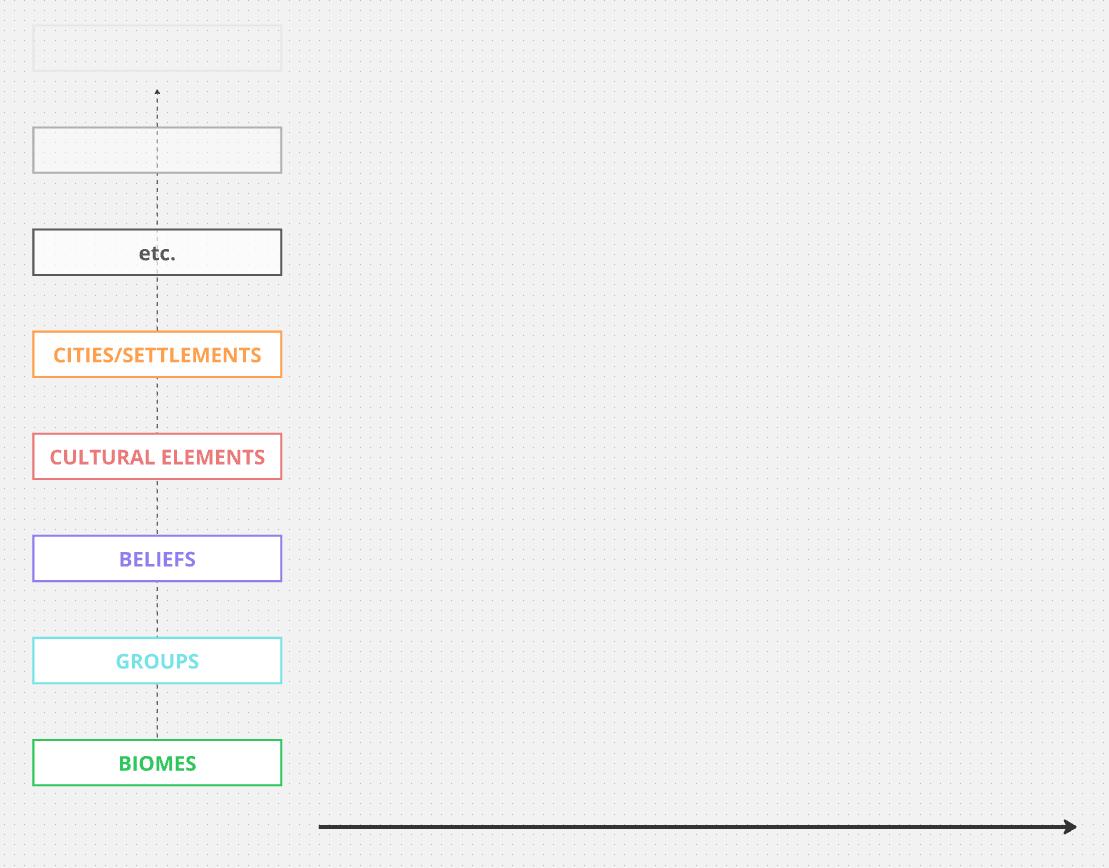
Example: This layered worldbuilding technic allows ideas to be organized into categories, which serves as the basis of a workshop to generate new ideas on top of each other. Each category is built on top the the other a represents an aspect of the world, and questions are asked to see the ramifications throughout all categories.
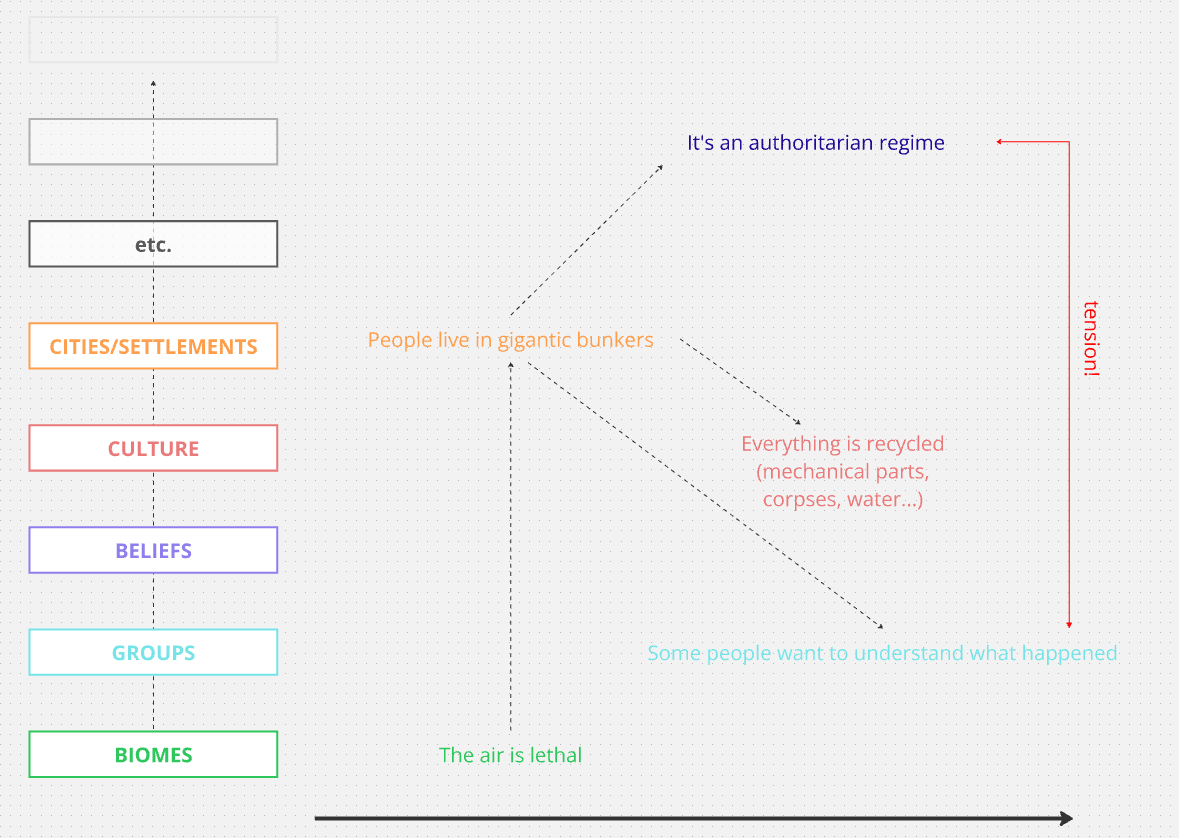
Example of a potential application of the tool using the “Silo” universe as an example.
This is one of many technics that I used, usually coupled with other sessions designed to find the DNA of a said fantasy and provide clear understanding to the teams.
Level design-centric worldbuilding: worlds as evocation
I have also specialized in Level design-centric worldbuilding, through research and a specific pipeline that allows me to translate creative intentions into spaces themselves.
The objective is that I believe the spaces themselves should tell a story even without the art, solely based on verticality, width, enemy placements, obstacles and perspectives. I want the bare, greyblocking to resonate story echoing the creative intentions.
I did that for all of my career, such as the following example :
In Mario + Rabbids : Sparks of Hope, our worlds were inspired by seasons. Having the ownership of a world, I therefore went all the way and separated each season in three (beginning, middle and end) to analyze their essence and translate this into interesting game spaces, using a technic resumed in this reconstruction:
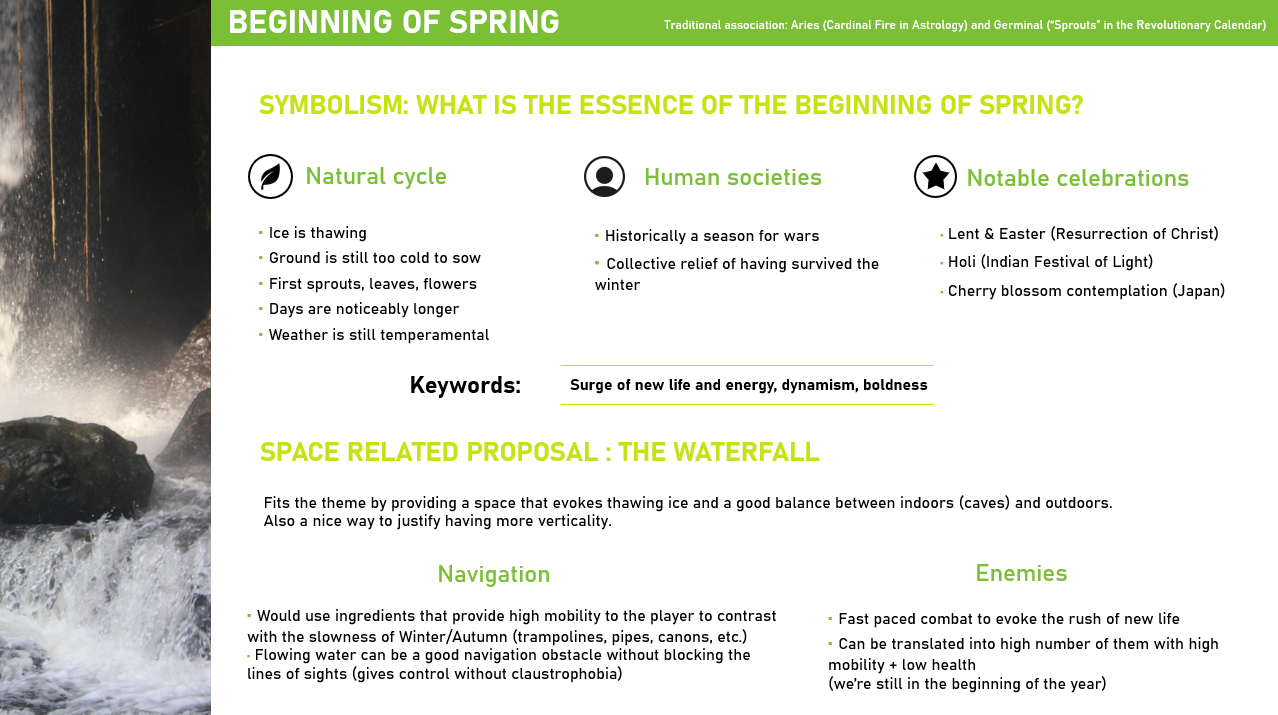
This was using a template I developed and used for the 12 regions of the world, following the same logic, and proposing rough greyblocks (Winter would have the mountain, the indoor and the lake, with lots of indoors, verticality and harsh environmental threats, while Autumn would be using more debuffing enemies and be centered around village, swamp and forest, etc.)
Worlbuilding grafting between game systems and IPs
Back at Ubisoft HQ, my tasks could also be assisting studios to find the branching points between an unexploited IP and a new game system pitch.
I was tasked in seeing how the world could benefit the systems and vice versa. Unfortunately I cannot disclose the specifics, but I can provide an example.
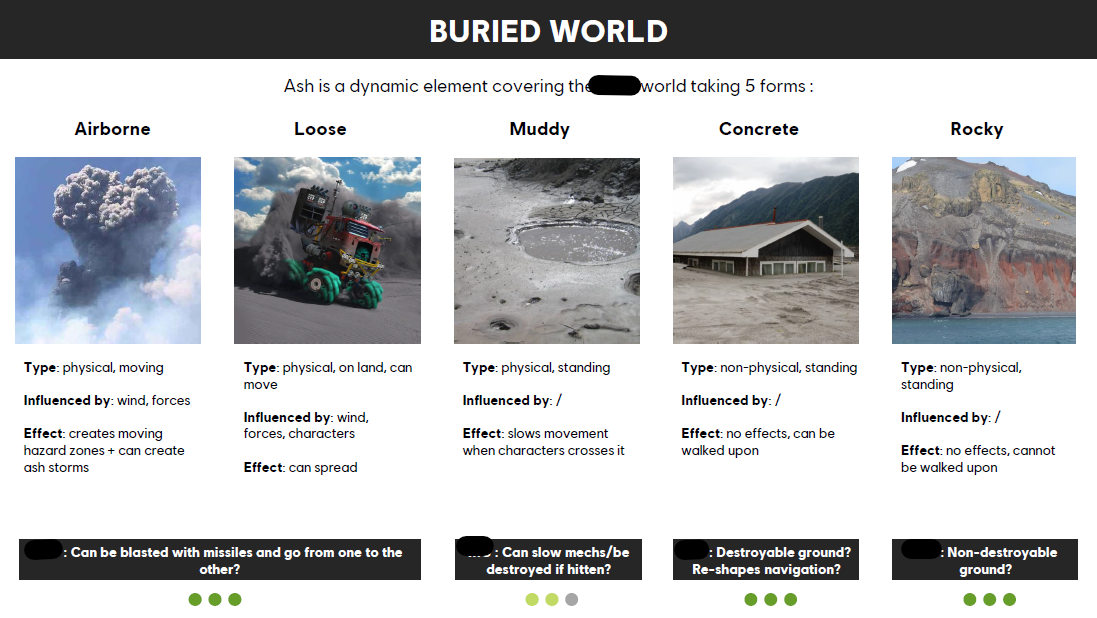
Example of the “Ash” potential I wanted to explore for an action game set in a dystopian future world.
Hence proposing documentation, references and potential ideas to guide the teams towards consolidating their world and making them more cohesive and impactful.
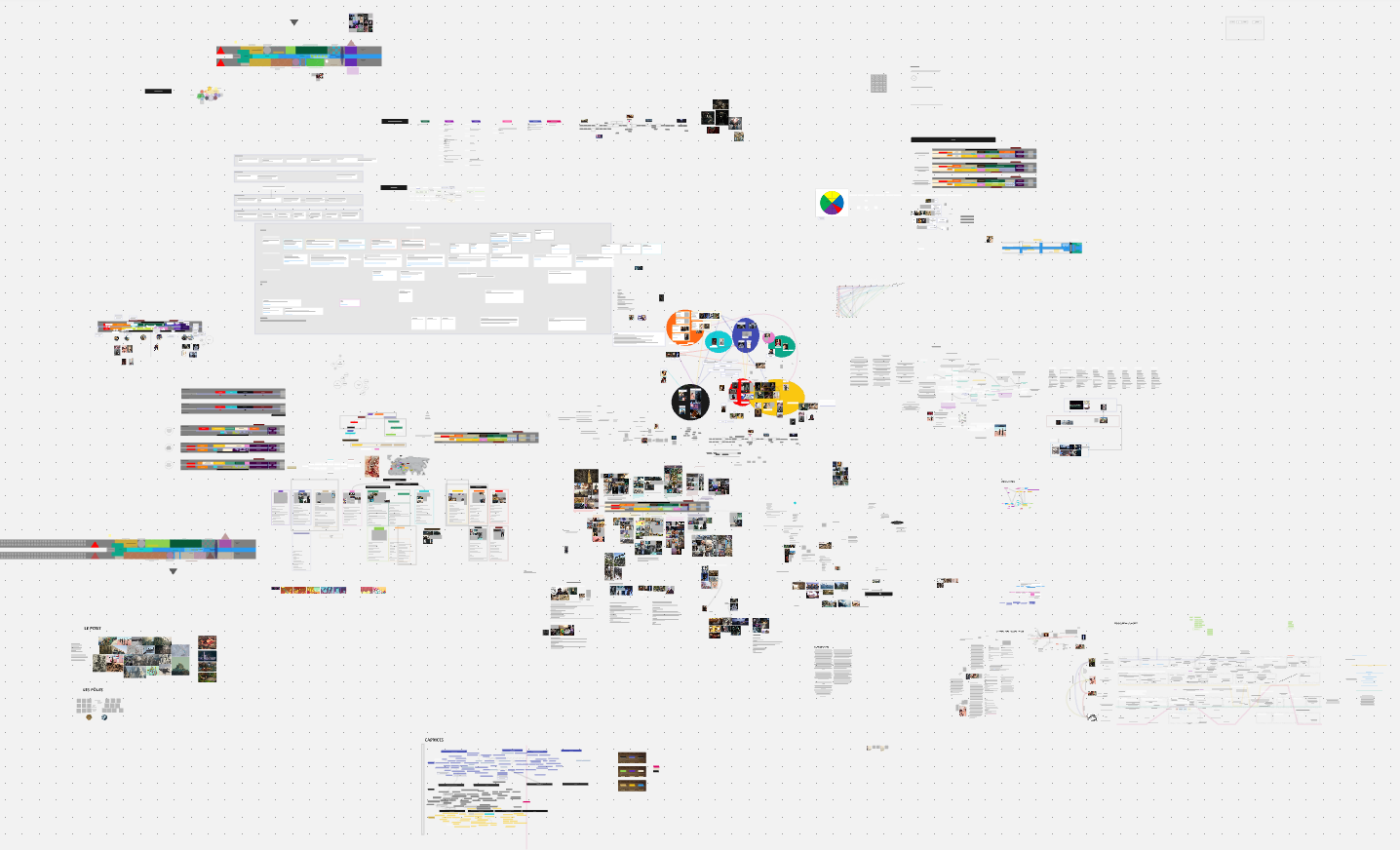
Many of these technics are also used in my personal project, on which I have worked for the last few years, as showed in this Miro screen mixing worldbuilding, moodboard, scenarii and categorized informations.